
사이트맵 ×

토탈산업
현대보테코

Business & people

엠쓰리파트너스
hnp인터프라
휴먼텍
한국마쓰이
기사제목
Source: CPRJ Editorial Team  Sacmi has developed a complete array of coffee capsule manufacturing solutions, with total running/management costs (TCO, total cost of ownership) that are said to be the lowest in the industry.▲ The technological core of the solution is Sacmi's CCM (continuous compression molding).The technological core of the solution is the continuous compression molding (CCM), the Sacmi compression press that, with just 32 cavities, lets manufacturers produce ultra-light capsules with superior quality/seal characteristics at speeds of up to 800 units/minute.Energy savings can top 30% compared to the alternative injection technology (thanks to the special, low-temperature extrusion process), according to Sacmi. The result is a combination of high productivity and the shortest cycle times in the industry (2.4-3.2s).Another key advantage is that with compression, each cavity can be managed independently. This possibility, exclusive to this technology, is a huge plus when it comes to both maintenance and quality control; the latter is also aided by the integration of Sacmi vision systems which operate in-line and at high speeds, allowing real-time identification of faulty capsules (and the relative cavity number to ensure immediate identification of the origin of the defect).Being able to process the material at lower temperatures and handle the plastic in a more viscous state has allowed Sacmi to develop applications for special, compostable materials, all against a TCO (total cost of ownership) that is at least 10-15% less than that of alternative solutions.Moreover, Sacmi provides support for closed systems (proprietary capsules) and open systems (i.e. the compatible pods that are steadily gaining more and more ground on the market). Through Sacmi Filling, the Group also offers complete development of capsules thermoformed with form-fill-seal technology.Market analysis suggests coffee capsule will account for over 75% of overall growth on the world coffee market from now until 2020. ▲ Over 30 billion plastic capsules are sold in a year. The solution will account for over 75% of overall growth on the world coffee market from now until 2020.https://www.adsalecprj.com/Publicity/MarketNews/lang-eng/article-67025982/tc-en_CPRJ_EN_20170329/NewsArticle.aspx
Ms. Kang 2017-04-07
기사제목
Written by  Joe Boomgaard GREENVILLE — A Pennsylvania plant closure could translate into growth in West Michigan for a global plastic injection molding supplier.  Earlier this month, Madison Heights-based DME Co. and parent company Milacron Holdings Corp. (NYSE: MCRN) detailed plans to consolidate its mold base manufacturing to a “new world class” plant in Greenville, Mich., located northeast of Grand Rapids.Cincinnati-based Milacron will close its DME Youngwood plant southeast of Pittsburgh and move its operations to Greenville later this summer, according to a statement from the company.DME President and General Manager Pete Smith said company wants to consolidate to one plant to “direct our investment funds to build a new world class site at Greenville,” which currently makes quick-change mold frames and mold insert systems.DME, formerly Detroit Mold Engineering, made metal mold bases at the Youngwood plant for use in the plastic injection molding industry. The move is expected to affect 63 people at Youngwood, which “was no longer able to compete cost effectively,” according to Smith. The company will help some interested Youngwood employees relocate to work at other Milacron sites “where possible.”In the statement, the company said it plans to update the Greenville facility, located at 1117 Fairplains St., although it did not specify its level of investment. Milacron Director of Marketing and Communications Michael Ellis declined to provide any additional information on Smith’s comments. “This facility will incorporate the latest state of the art manufacturing processes and, together with its location, it will be ideally positioned to service customers throughout North America,” Smith said in a statement, referring to the Greenville plant.West Michigan has one of the highest concentrations of tool and die makers in the country. According to the U.S. Bureau of Labor Statistics, the industry is nearly 7.5 times more concentrated than normal in the Grand Rapids-Wyoming metropolitan statistical area. The companies in the MSA pay an annual mean wage of $48,410.According to data from The Right Place Inc., a regional economic development group, 130 tool and die shops operate within a 75-mile radius of Grand Rapids. They employ more than 4,300 people in the region, and hired nearly 800 workers between 2011 and 2016.Most tool and die companies in the region supply automotive and furniture manufacturers, according to the data.A spokesperson for The Right Place declined to comment on whether the agency was working with Milacron around the company’s plans for Greenville.Milacron generated nearly $1.2 billion in sales for the full year in 2016 and had operating earnings of $105.6 million, or 43 cents per diluted share, according to an statement issued last month. The company had $130.2 million in cash on its balance sheet as of Dec. 31.In providing guidance for 2017, Milacron said it expects flat sales to growth of 2 percent, according to its earnings statement. It also plans to commit around $50 million in capital expenditures during the year.https://mibiz.com/item/24650-milacron-dme-to-consolidate-mold-base-manufacturing-to-%E2%80%98new-world-class%E2%80%99-greenville-plant
Ms. Kang 2017-04-07
기사제목
Ms. Kang 2017-04-07
기사제목
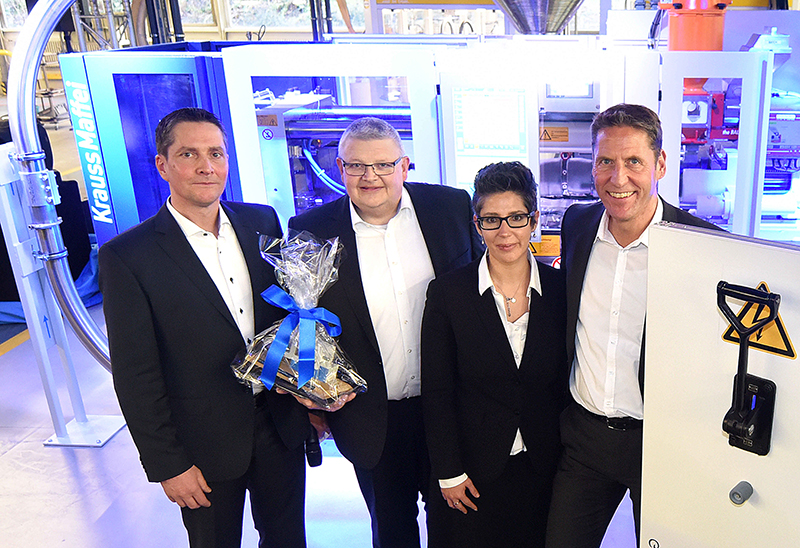
Ceremonial handover of the anniversary machine: Lars Thielke, (Grohe Production Manager, Plastic Injection Molding), Hans-Martin Souchon (Grohe Plant Manager, Porta Westfalica), Nadine Buhmann (Vice President Sales, Injection Molding Machinery, KraussMaffei) and Thomas Fuhr (Chairman of the Board of Grohe AG) (left to right) - Ceremonial commissioning of the new CX 80-380 in Porta Westfalica - Many years of successful cooperation - Configuration of a new automated production lineAt the end of January, KraussMaffei ceremonially commissioned its 100th injection molding machine at Grohe, the leading manufacturer of sanitary fittings, showers and installation systems. The hydraulic two-platen machine CX 80-380 is part of a new, economical production line at the Porta Westfalica location for the manufacture of the latest generation of Grohe drain valves. Decades-long trust"We have benefited from the innovative products and the tailored service provided by KraussMaffei for decades. We are now delighted that the 100th injection molding machine from our long-term partner is now at our factory in Porta Westfalica," says Thomas Fuhr, Member of the Board of Management at Grohe AG. "This is a strong symbol both for our good cooperation with KraussMaffei and for the sustained growth and continual further development of our location."In 1981, KraussMaffei delivered the first injection molding machine to Grohe. There are today in total 37 KraussMaffei injection molding machines at the Porta Westfalica location. The new CX 80-380, with a clamping force of 800 kN, supports the modern production line manufacturing the new Grohe range of drain valves in cisterns. The injection molding machines produce around the clock seven days a week. Online production and thus short distances, no warehouse stocks and a high degree of automation characterize the new AV1 production line. It is therefore all the more important that the injection molding machines produce precisely and reliably, and with optimum utilization of the installation area. The view at Grohe is that, with the new CX series and service from KraussMaffei, they are optimally set up.Applause for the anniversary machine: The teams from Grohe and KraussMaffei celebrate the 100th injection molding machineGrohe also sees a clear additional benefit in the APC function (Adaptive Process Control). All KraussMaffei machines are today equipped with this new machine function. They have thus been able to deal perfectly with the batch fluctuations of up to 17 per cent of the basic material. Also with regard to the anniversary machine CX 80-380, on which float flaps are made from the high-tech plastic POM, the compensating properties of the APC function prove beneficial.Geared for growthThe unit with the anniversary number can be identified at first glance by every employee and visitor also after the ceremonial inauguration. For it bears the words "100th - Made for Grohe", as well as the signatures of the persons who symbolically actuated the main switch during the ceremonial commissioning. This further addition of another production machine to the factory forms part of the investment package of Grohe AG at the Porta Westfalica location.
강민정 2017-02-16
기사제목
Elite metal AM laboratory operations exceed industry standards ▲ As part of its material characterization lab, Sintavia offers comprehensive Mechanical testing capabilities using some of the most advanced equipment available. Typical mechanical testing properties include elasticity, tensile strength, elongation, hardness, fracture toughness, impact resistance, creep, stress rupture and the substantiation of fatigue limits. Sintavia, LLC, the global independent leader for metal Additive Manufacturing (AM) services, announced today that its metallurgical laboratory had received ISO 17025 accreditation by the American Association for Laboratory Accreditation (A2LA). ISO 17025 is the highest recognized quality standard in the world for calibration and testing laboratories. For an organization to be accredited in ISO 17025, its laboratory must be able to consistently produce precise and accurate test and calibration data.   “As the first dedicated AM manufacturer to achieve ISO 17025 accreditation Sintavia once again is at the leading edge of the industrial application of AM technology,” said Doug Hedges, Sintavia’s President and COO. “Serial production is all about serial quality, and this achievement speaks to our commitment to the highest standards at every step of AM production. From when the powder arrives at our facility to when the finished parts leave the dock, we maintain complete control over the integrity of the product. Anything less would be a disservice to our customers.” ▲ Sintavia possesses one of the most advanced and sophisticated metallurgical analysis laboratories in the world. Sintavia offers the full range of metallographic preparation capabilities including sectioning, mounting, grinding, polishing and etching. This in-house capability is critical for material and parameter development.Until now, AM manufacturers offering ISO 17025 accredited testing had to use independent laboratories for powder and material validation. While quality analysis can be achieved by shipping samples to a third-party laboratory for powder analysis, metal density testing, and quality assurance verification, having an accredited laboratory within the AM production facility means faster analysis and complete security of the process.   “What a great year it has been for quality improvements,” added Alex Bencomo, Quality Manager at Sintavia. “To get both AS9100 certification and ISO 17025 laboratory accreditation in a single year is a significant accomplishment. As we grow, we are committed to staying focused and continuing to incorporate the highest quality standards in the industry.”   For more information, please go to http://www.sintavia.com
강민정 2017-01-16
기사제목
▲ New partners in Iran: Klaus Bange (Director of Sales IMM EMEA KraussMaffei), Hervik Yarijanian, (General Manager KSF) and Rachid Douibi (Senior Area Sales Manager KraussMaffei) (from left)   - Experienced plastics specialist KaranSimaFam to support Sales and Service for KraussMaffei injection molding and reaction process machinery - Growth potential in the business areas of vehicle construction, packaging and medical technologyKraussMaffei has a new agency in Iran and thus wants to further strengthen its market position in injection molding and reaction process machinery in this region. KaranSimaFam, a family-run company in the Iranian plastics industry with over 50 years of experience, represents KraussMaffei with the new company Krasifam (KSF).   Long tradition   "We are very proud to have gained KaranSimaFam, an established and experienced partner in the Iranian plastics industry. The Yarijanian family looks back on a long tradition and has had contact with plastics processors in Iran for many years. I am delighted in particular that the founder and Managing Director Hervik Yarijanian will be responsible for looking after the customers of KraussMaffei," explains Klaus Bange, Director of Sales IMM EMEA at KraussMaffei. The customer support for KraussMaffei includes consultation for the design of machines and automation, commissioning and a number of individual services throughout the entire service life of the plants. In the east of Teheran, a district where much of the plastics industry is located, a completely new administration and service building for KSF is currently under construction. The company's own spare parts warehouse is also being built there in order to ensure rapid reaction times for ordering and delivery.   KraussMaffei sees particular interest for the Iranian customers above all in the automotive industry, packaging and medical technology sectors. Here, automated injection molding machines are needed with low, medium, but also high clamping forces. "With our broad portfolio of hydraulic and all-electric injection molding machines in the four series CX, GX, MX and the new PX, we are ideally positioned," said Klaus Bange. Furthermore, KraussMaffei Reaction Process Machinery offers a wide range of mixing and metering systems, as well as mold carriers. These products will appeal in particular to automobile manufacturers and suppliers, as well as producers of refrigerators and providers of insulation solutions.
관리자 2017-01-13
기사제목
On December 6, 2016, the Korean branch of KraussMaffei held T.R.E.N.DDay, 2016 Tech. Seminar, in Suwon, Korea. Handler,a plastics journal in Korea, interviewed Jochen Mitzler and Marko Zorn from KraussMaffei,and asked KraussMaffei its strategy in the Korean market, and how they preparefor Industry 4.0. THIS INTERVIEW WAS CONDUCTED BY MINJEONG KANG FROM PLASTIC HANDLER, REPUBLIC OF KOREA▲ JochenMitzler, Head of Strategic Product Management in KraussMaffei TechnologiesGmbH(left), and Marko Zorn, Key Account Manager for Korea Injection MoldingMachinery in KraussMaffei Korea Ltd.(right)*FiberForm: FiberForm entails the thermoforming andover-molding of organic sheets, which are plate-shaped semifinished productswith continuous fibers made of glass, carbon or aramid embedded in athermoplastic matrix made of polyamide (PA), polypropylene (PP) or other matrixsystems. In this process, these semifinished products are first heated,reshaped in the injection mold and then back-injected with a fiber-reinforcedpolymer. Parts with integrated organic sheets have significantly bettermechanical properties compared to those that are purely composed ofshortfiber-reinforced injection molding material.*ColorForm: The ColorForm process is used to replace classic paintingprocesses, including the up- and downstream working steps for conventionallacquering. This cuts investment costs and boosts logisticsefficiency; the scrap rate is lower and parts transport is higherDuring the ColorForm process, a thermoplasticbase body forms in a mold, which is then flow-coated directly in the cavityusing a two-component polyurea (PUA) or polyurethane (PUR) paint. The result: afinished component with the desired lacquered color capability and premiumquality surface.*T-RTM(Thermoplastic Resin Transfer Molding): The T-RTMprocess has various benefits over parallel plastic processing procedures, e.g.the familiar RTM with epoxy resin or polyurethane (PUR). The low viscosity ofjust five millipascal-seconds (mPA·s) – similar to water – allows the matrixmaterial caprolactam to penetrate the fiber layers even with low internal moldpressures. The relatively low clamping force reduces costs for investment andenergy. In addition, the high flow capacity allows the minimum wall thicknessto be reduced and the fiber volume content increased by about 60 percent.▲ APCplusIn the intelligent machine area, we have a new function developed whichis called APC(Adaptive Process Control) plus. It embodies the idea of intelligent machines, a concept that refers toself-optimizing machines, which improve productivity and quality. This functionalways analyze the viscosity of the melt which goes into the mold when we makean injection. If the melt quality(viscosity) has changed, the machine has thesmart function to make an automatic adjustment of the process. We always wantto have good parts. If the machine doesn’t have this function, it could be thatthe parts are over-molded, or not completely filled, due to the change of thematerial viscosity. To avoid scrap rates, we have a certain kind of brain inthe injection molding machine which we call APC plus. APC plus is just onesmall stone of the intelligent injection molding machine.▲ DataXplorerSecondly, for interactive production, we have a special communicationsetup to the mold and the drying systems. Plastic resin often has to be dried,so we use dryers. From the dryer, it is getting converted to the injectionmolding machine. If the drying is not in the good quality, you will produce badparts. So the communication between the machine and the dryer allows us thatthe dryer tells the machine has a problem, or the machine tells the dryer has aproblem. It asks to stop processing when we have to adjust something in themold not to overheat the material, or even not to load untried material in theinjection molding machine.▲ E-ServiceLastly, intelligent service is that we have possibilitiesto get access to the injection molding machine over the internet to have afaster reaction on the service side to the customers. For example, if customersin Korea have an issue, they can allow someone from Munich to have a look onthe machine so that we can make a pre-diagnosis. Then, from Munich, we canadjust the process and machine. Therefore, we save a lot of time for customersinstead of spending time travelling forward and backward, and reduce downtimeas well.
강민정 2017-01-09